Ease of Doing Business in Pakistan: Breaking Banking Barriers and Unlocking SME Growth
Pakistan’s SMEs contribute nearly 40% of GDP and employ 80% of the non-agricultural workforce, yet structural barriers in banking, financing, and policy implementation continue to restrict growth. This article highlights key bottlenecks and outlines urgent policy actions to unlock real ease of doing business for entrepreneurs.
.jpeg&w=128&q=75)
Zahid Ali Shah
Published on February 16, 2026
Ease of Doing Business in Pakistan: Opportunities, Barriers, and Policy Action for Small Businesses & Entrepreneurs
Introduction
Small and medium enterprises (SMEs) are the backbone of Pakistan’s economy. Around 5 million SMEs are operating in Pakistan, contributing roughly 40% of GDP, about 25% of exports, and employing nearly 80% of the non-agricultural labor force.
Despite this economic significance, the ease of doing business for small enterprises remains constrained by structural, institutional, and implementation challenges especially in financing, banking services, and policy execution.
Business Registration: Digital Progress
Pakistan has made significant progress in digitalizing company registration processes. Over 35,000 new companies were registered in FY 2025, with monthly incorporations reaching record highs. Nearly all registrations are now processed digitally, demonstrating strong adoption of regulatory reforms.
These statistics show that digital registration reforms are working. However, registration is only the first step in building a sustainable business.
Banking & Financial Inclusion: A Critical Policy Gap
While policy directions have been issued to simplify SME account opening and promote digital onboarding, practical challenges remain at the commercial bank level.
Entrepreneurs frequently report about lack of clarity regarding documentation for Limited Liability Partnerships (LLPs), Limited Liability Companies (LLCs) and newly incorporated setups. Additionally they come across
- Delays in opening corporate bank accounts
- Requests for additional or non-standard documentation
- Limited understanding of startup and digital business model
- Manual verification of organizational registration documents though the businesses were digitally registered with SECP
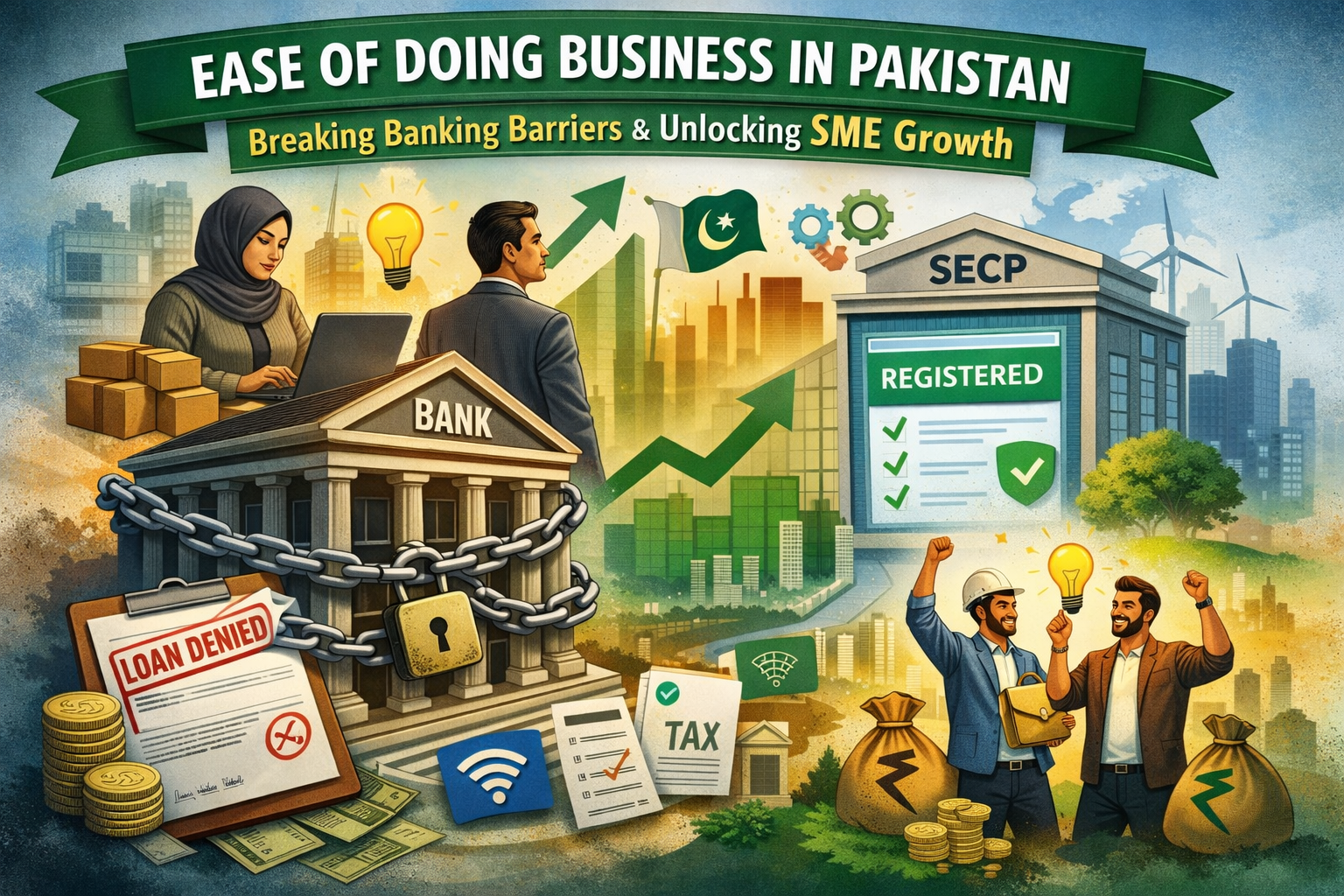
This disconnect between regulatory intent and branch-level implementation creates a serious bottleneck. Many newly registered businesses struggle to operationalize due to banking delays. The banks still require the businesses to give business address rather than accept the concerns as virtually established and registered with the relevant regulators. To improve ease of doing business, regulatory directives must be consistently implemented across all bank branches with measurable compliance standards.
SME Financing: Structural Barriers Persist
Despite SMEs contributing nearly 40% of GDP, their share in private sector credit remains below 8%, which is significantly lower than regional averages.
Limited access to formal credit restricts growth, innovation, and scaling particularly for youth entrepreneurs, women-led businesses, and home-based enterprises. Venture financing is crucial for enabling startups and MSEs to innovate and scale, yet in Pakistan it remains limited due to risk-averse banking systems, weak early-stage investment ecosystems, regulatory uncertainties, and low investor appetite for equity-based financing.
Policy Actions Needed:
1. Enforce SME credit targets for banks
2. Standardize documentation requirements nationwide
3. Promote fintech, alternative finance, and equity mechanisms
4. Establish dedicated SME desks at bank branches
5. Introduce performance-based incentives for SME lending
Compliance, Taxation & Digital Literacy
Pakistan has digital tax filing systems in place, but many small businesses still face compliance anxiety due to documentation complexity and lack of advisory support. Ease of doing business should mean that entrepreneurs can independently navigate compliance processes without excessive reliance on consultants.
Infrastructure & Market Readiness
Reliable electricity, broadband connectivity, and logistics infrastructure remain uneven across regions, limiting business competitiveness especially in smaller cities and rural areas.
Toward Real Policy-Driven Ease of Doing Business
True ease of doing business for SMEs requires:
- Seamless bank account opening
- Access to credit without disproportionate collateral
- Clear and uniform documentation requirements
- Integrated digital compliance systems
- Grassroots financial and digital literacy programs
Closing the SME financing gap, ensuring banking sector alignment with regulatory directives, and strengthening institutional accountability will determine whether Pakistan can fully unlock its entrepreneurial potential.
Integrated platforms like HUB by Krafters can play a vital role by bridging institutional gaps and connecting entrepreneurs with finance, compliance systems, advisory services, and market linkages — turning policy into practical business success.